
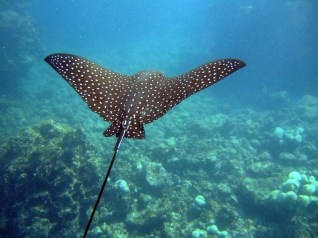
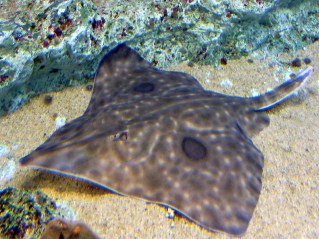
Rays and skates are possibly the most majestic and elegant marine creatures, but they can also be the most deadly.
Together with sharks, they form the subclass elasmobranchs, which are characterised by their skeletons consisting of cartilage instead of bone. This is because cartilage is flexible, durable and lighter than bone making them perfectly adapted to life underwater. But they would be vulnerable on land, due to air being more dense than water.
The elasmobranchs are then further subdivided into two super orders Selachii (sharks) and Batoidea (skates and rays). The rays are then split into two orders electric rays (Torpediniformes ) and sting, devil and eagle rays (Myliobatiformes). Whilst, the skates have one order (Rajiformes). Although, skates and rays are very similar with their flattened bodies and long tails, there are a few distinct differences.
Differences between skates and rays
- Rays have venomous stinging barbs on their tails, whereas Skates have rows of spikes instead for protection.
- Skates tails tends to be stockier while rays are whip-like and slender
- Skates also have a shorter tail and their pelvic fin can have two lobes instead of just one; the first lobe sometimes resembles a small modified foot, called a crus, and can be used to help movement.
- Skate have a dorsal fin whilst in rays it is either absent or reduced.
- Skates reproduce by laying eggs whilst rays birth live young.
The main way I remember the difference is that skates are more kite shaped, whilst rays are more rounded!
Conservation
Unfortunately, large flat-bodied coastal species are the most vulnerable to extinction because of habitat loss and over-exploitation. Reasons for the vulnerability of sharks, skates and rays are;
- Slow growing and late to mature
- Long pregnancies
- Produce few young
- May not reproduce every year
IUCN recorded that 181 shark and ray species are at risk of extinction!
Thanks for reading.

 Travel, Oceans and Sunsets